

Dealing With Discouragement
Five things you can do to battle depression & discouragement


A study of 1 Kings 19 by Pastor Brian Larson
I was never a surfer but growing up in southern California, I did do some bodysurfing, and I remember one thing: if you’re riding the crest of the wave, watch out! You’re going to get slammed!

Chapter 18 of 1 Kings ends with the prophet Elijah on his greatest spiritual high, short of when he would eventually be taken by God to heaven without dying. Elijah had just stood alone against 450 prophets of Baal on Mt. Carmel in a contest designed to prove the futility of idolatry and the deity of the God of Israel. In the end, it was no contest; God sent down literal fire from heaven to prove Elijah’s point.
Watch Pastor Brian teach about Elijah at Mt. Carmel in Israel.
Immediately, the people of Israel killed the prophets of Baal and shouted, The Lord, He is God! Elijah then went to the top of Mt. Horeb and prayed for God to end a three-year drought in the land of Israel. The Lord obliged him with a true gully-washer.
It’s always exciting to see God work, to witness a miracle of the Lord. But, after every great spiritual experience, watch out! Satan is just waiting to cut God’s people down to size. Paul warns us in 1 Corinthians 10:12:
Therefore let him who thinks he stands take heed that he does not fall.
It is amazing. This same Elijah, who had been riding the crest of a spiritual wave, in 1 Kings chapter 19, becomes discouraged, depressed, defeated and runs for his life at the threat of one woman, the infamous Jezebel, queen and wife of Israel’s King Ahab. She was a wicked person, even instigating a wholesale massacre of the prophets of the Lord. Outraged by the killing of the 450 prophets of Baal at the hands of the people of Israel, in 1 Kings 19:2, Jezebel sends a messenger to Elijah, saying:
“So may the gods do to me and even more, if I do not make your life as the life of one of them by tomorrow about this time.”
There’s the threat: Within 24 hours, Elijah, you’re dead. And it was a threat! Yet, that’s probably all it really was—a threat. If the queen had really wanted Elijah dead, there was no reason that she couldn’t have sent someone to kill him right then.
Almost all of our fears are the product of threats, not reality. We have an idea of what we think is going to happen. When we feel threatened by circumstances, the enemy often creates mirages of doom. However, because of the promises of God to the children of God, that’s all they are — mirages.
You know why everything looks lousy sometimes? Because mentally we have put on manure-colored glasses, that’s why! We’re going around saying, “Oh, this stinks. That stinks. Everything stinks! Those roses over there, they stink!”
So, how did Elijah, this mighty man of God, react to the queen’s threat? It says in verse 3:
And he was afraid and arose and ran for his life and came to Beersheba...
The distance between Jezreel (where Elijah had been) and Beersheba was between 120 and 140 miles. When he got to Beersheba, he still didn’t feel safe:
But he went himself a day’s journey into the wilderness, and came and sat down under a juniper tree; and he requested for himself that he might die, and said, ‘It is enough; now, O Lord, take my life, for I am not better than my fathers.’”
Elijah had just reached rock bottom, spiritually. He was obviously physically exhausted, discouraged and depressed. Spiritually he was defeated. This great prophet Elijah, the one who would someday stand with Jesus on the Mount of Transfiguration, one of only two men in the history of this world who God took into heaven without dying, was hiding in the desert, wanting nothing more than to die.
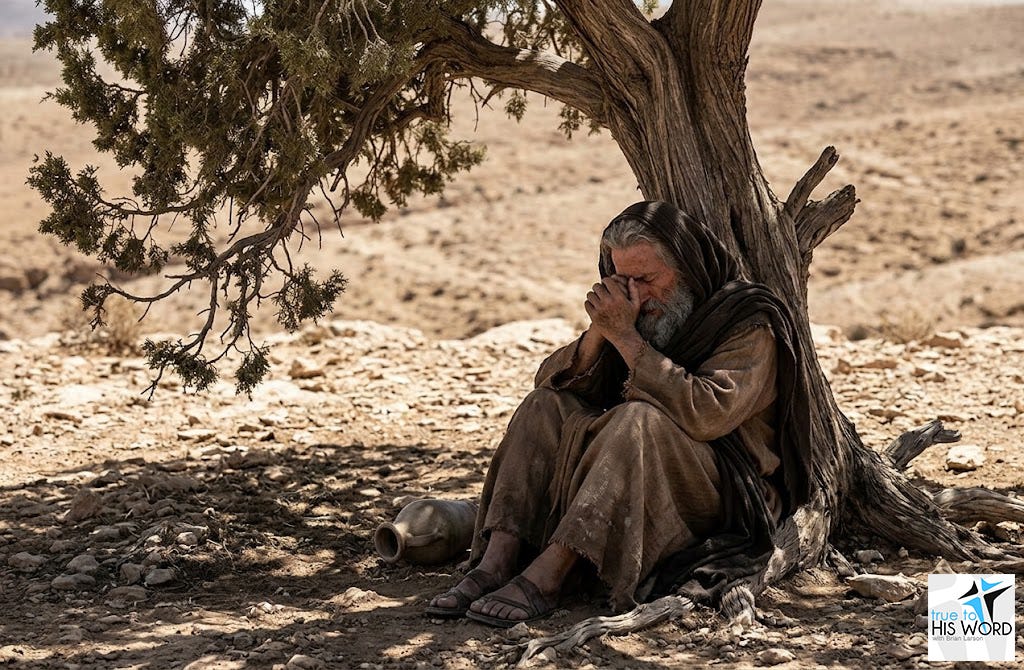
It’s easy to see why Elijah would have been depressed. After that contest on Mt. Carmel, Elijah probably thought revival was going to sweep Israel. Instead of that, he got a death threat! Things didn’t happen the way he expected them to happen. How often our own expectations can derail us spiritually! We get an idea in our mind of what we expect God to do, but those expectations of ours can cause so much discouragement and so much pain! That very likely is what happened to Elijah.
So how does God deal with his discouraged and defeated prophet? It’s important for us to answer that question because every one of us is susceptible to discouragement. Every one of us is susceptible to depression. Every one of us is susceptible to feeling spiritually defeated. In studying how God dealt with Elijah in chapter 19 of 1 Kings, I believe God shows us how to deal with discouragement. I would like to point out five things that can help us, based upon how God ministered to Elijah.
1. Take Care of Yourself Physically
Before God had a thing to say to Elijah, He ministered to his physical needs. Elijah was absolutely, totally exhausted. In verses 5 through 8, God sent an angel to minister to Elijah by allowing him to sleep and by feeding him nourishing food.
One of the first things to do when it comes to feeling discouraged or depressed is to take care of yourself physically. Get proper rest. Get proper food. That’s probably one of the best ways you can help yourself spiritually. We’re all like children. You know how kids are when it gets late at night? They get tired and what do they become? Cranky! I remember my folks telling me, “You’re tired. You need to go to bed.” I sat there complaining, “What are you talking about? This has nothing to do with being tired! I’m not tired! I don’t need to go to bed! He took my pencil, that’s what this is about!” Five minutes later I was conked out, sleeping like a log.
Adults are the same way! When we get physically exhausted we start fretting, Oh, where did God go? Why am I not walking victoriously? What’s going on here? Have you deserted me, God?
God’s reply may be, Oh, just go to sleep!
Take care of yourself physically. That’s more important than I think we realize.
2. Recognize God’s Presence
Secondly, although God’s presence is not always obvious, He is always there for you. Even though He doesn’t always send down fire from heaven, He is always working on your behalf, often in ways you’ll never recognize. As it shows in verses 9 to 18, God had not forsaken Elijah, even while he was hiding out in a cave on Mt. Sinai (another name for Mt. Horeb). Elijah was about as far away from civilization as a he could possibly get. But God met him there.
“…and behold, the word of the Lord came to him, and He said to him, “What are you doing here, Elijah?” He said, “I have been very zealous for the Lord, the God of hosts; for the sons of Israel have forsaken Your covenant, torn down Your altars and killed Your prophets with the sword. And I alone am left; and they seek my life, to take it away.”
How bad could things get? Elijah’s saying, I’m the only one left! And I’m hiding out in the desert because they want to kill me! It couldn’t be any worse than this!
Our attitude is often tied directly to the way we perceive things. You know why everything looks lousy sometimes? Because mentally we have put on manure-colored glasses, that’s why! We’re going around saying, Oh, this stinks. That stinks. Everything stinks! Those roses over there, they stink!
God is trying to impress upon us that we are not to act according to the way we perceive things to be. Instead, we must stand upon His Word. As you look at your circumstances, simply say, Well, I don’t know about that! I’ve got to admit, that doesn’t look good, but one thing I do know … and stand on a promise of God.
So, God says to Elijah, Elijah, what are you doing here? Notice that Elijah doesn’t answer the question. God didn’t ask him why he was there. He asked him what he was doing there.
The point is, Elijah was allowing fear and panic to dictate his actions, that’s what he was doing there. God illuminated the truth of Elijah’s circumstances, causing Jezebel’s mirage of doom to flee in the light and truth of His presence. Allow Him to do the same for you.
3. Spend Time With The Lord
Thirdly, it’s always important to just spend a little time with the Lord, especially when you feel like you’ve just been run over by the enemy’s bulldozer. In verses 11 and 12, God ministers directly to His discouraged child:
“So He said, “Go forth, and stand on the mountain before the Lord.” And behold, the Lord was passing by! And a great and strong wind was rending the mountains and breaking in pieces the rocks before the Lord; but the Lord was not in the wind. And after the wind an earthquake, but the Lord was not in the earthquake. And after the earthquake a fire, but the Lord was not in the fire; and after the fire a sound of a gentle blowing.”
I love the way the King James Version translates that little phrase a “sound of gentle blowing” as “a still small voice.”
“When Elijah heard it, he wrapped his face in his mantle, and went out and stood in the entrance of the cave.”
The wind, the earthquake and the fire represent those circumstances in life that are attention-grabbing, that have a tendency to cause fear, anxiety and nervousness, that are always demanding your time and your attention. It’s also the busyness and activity with which we fill our schedules and our lives.
We’ve almost always got to be doing something. We’ve always got to have some noise blaring. Yet, when the big wind came, God wasn’t there. The earthquake came, and God wasn’t there. The fire came, and God wasn’t there. Finally there was a still small voice and Elijah went to listen to God.
God is telling you that a hurry-up, noisy lifestyle is not conducive to hearing the voice of the Lord. You won’t find the Lord in all that busyness. Take that time just to listen to the Lord. Turn the noise off! Just commune with Him for a while. Let Him talk to you.
My favorite time of the day is first thing in the morning. I’ll get up between 5 and 5:30, go down to our living room and open up the Bible just for myself. I’ll sit there in the quietness of the morning, before it’s even light outside, before there’s any activity in the house, and I’ll read the Word a little bit, and pray a little bit. It just starts my day off right!
I think this is one thing that God was trying to get across to Elijah. Elijah, you’re very worried. You’re very afraid. What are you doing in this cave in the middle of the desert? All you’ve been concentrating on is the wind and the earthquake and the fire. Come to me and listen to me.
Regardless of how you’re feeling or how badly things are looking, there is value in just saying, God, I’ll settle on this. You’re here. You have not left me and you have not forsaken me. I don’t understand anything else, but thanks for that. You can do that.
Instead of over-analyzing all the circumstances, go take a walk with God. Ask Him for His direction and guidance, for His battle plan for the moment. What do I do now, Lord? Look for that unique provision and care of His, instead of telling God what He’s got to do, how He’s got to do it, and when it’s got to happen. Look for what He’s going to do in His timing, His way, His faithfulness.
God has ways that we know nothing about. Look at Elijah in the pages preceding chapter 19. First of all, ravens fed the guy. Who would have thought? Ravens! Then he stayed with a widow who had this little cruse of oil and a little jar of flour — just enough for one little cake. Yet it lasted for three and a half years and fed her family, plus Elijah.
That says to me that you should take that need, take that life of yours, and just lay it down before the Lord. Look to Him and say, Lord, let’s see what you’re going to do here. God has ways of operating, meeting needs, using us, glorifying His name, being faithful to us, and fulfilling His promises to us that we know nothing about. Believe me, He’s got a repertoire of tricks that you cannot even imagine. So quit trying to figure it out. Do yourself a favor and just be like a little child and trust Him. He delights in surprising you with His faithfulness, especially when you feel like, That’s it! It’s over!
4. Just Get Busy
Then, fourthly, when discouraged, just go about doing what God has given you to do at that moment. In verses 15 and 16, God has specific tasks laid out for Elijah to do.
And the Lord said to him, “Go, return on your way to the wilderness of Damascus, and when you have arrived, you shall anoint Hazael king over Aram; and Jehu the son of Nimshi you shall anoint king over Israel; and Elisha the son of Shaphat of Abel-meholah you shall anoint as prophet in your place.”
The Lord is saying here, Elijah, here is My word to you now, in your condition, in the place that you’re in right now. Just get back to work. Go about doing today what I have given you to do today, and don’t worry about everything that is happening, or what it looks like may happen!
I think one of the greatest anecdotes to discouragement is to one day, one hour, one minute at a time, go about doing that which God has laid before you to do. Just get busy with those simple little tasks, and make them an offering, a sacrifice, a work given to Him. Maybe it’s washing the dishes. Maybe it’s doing the laundry. Maybe it’s taking a nap. Maybe it’s making that phone call. Ask God for the help and the strength to do it—then just do it.
There have been times when I have been so incredibly discouraged and depressed that my stomach was in knots! Yet, I would have things I would need to do that day. So often it has been like the Lord is saying to me, Well, Brian, the first thing I want you to do is get out of bed, take your shower and get dressed. Can you do that?
Yes, Lord, I think I can handle that.
Now, I want you to get in your car and drive downtown. Can you handle that one?
Yes, Lord, I can handle that one.
Then, just one thing at a time, I’ll go through the day with the Lord.
Just go about doing what he has set before you to do, and let Him take care of all the other stuff that’s going on. Say, Lord, I’m just going to serve you today, with what you’ve given me to do. I don’t know what’s going to happen and I don’t know what it all means, but I’ll just do what you’ve given me today to do and I’ll let you take care of tomorrow.
That’s what He’s telling Elijah here: Elijah, here’s my word to you. I’ve given you something to do. Do it.
It’s interesting to me that God wanted Elijah to go to Damascus. Damascus is 180 degrees in the opposite direction from Jezreel, just as Mt. Sinai is in the other direction. So, when Elijah took off in a panic, he went in exactly the opposite direction of the direction the Holy Spirit would have led him. Isn’t that the way it is? If we let fear and panic control our actions, we’ll end up doing exactly the opposite of what God would have us to do.
In verse 17, God says, “It shall come about, the one who escapes from the sword of Hazael, Jehu shall put to death, and the one who escapes from the sword of Jehu, Elisha shall put to death.”
You know what He’s saying here? Elijah, I am going to judge. I will vindicate. I am going to do what I’m going to do no matter how discouraging and impossible this situation might look to you.
What a message to us, brethren. God will do His work, He will keep His promises, and accomplish His purposes—and it does not depend on how it looks to you. What God is saying here is, Elijah, I’m going to do it.
5. You’re Not Alone–So, Don’t BE Alone
Finally, remember, you are not alone. When I say you are not alone, I don’t just mean that the Lord is with you, as real and true as that is. I also mean, there will always be people who love Jesus there with you.
In verse 18, God tells Elijah, “Yet I will leave 7,000 in Israel, all the knees that have not bowed to Baal and every mouth that has not kissed him.”
In other words, God is saying to Elijah, There’s one other thing I want you to know. You’re not alone. You just told me you were the last one. Well, guess what? You’re not.
God has always had and He always will have what the Bible often calls His faithful remnant. You are not alone if you’re going to follow Him. So my counsel to you is, because you are not alone, don’t be alone. When we’re feeling like we’ve been massacred by the enemy, and we just want to find a little hole somewhere, a little cave somewhere on Mt. Sinai to privately lick our wounds, that is probably when we most need to be amongst the 7,000, enjoying the encouragement of our mutual faith in Jesus Christ.
There will always be a mass and a multitude of people who will fall away. There will always be those in the church who are big hypocrites. There will always be those who will come on strong and then just fade away. There will always be those who will just go right back into the world. There will be those who look like they’re the strongest, most dynamic, most spirit-filled, most mature Christians who absolutely flake out, leaving you to wonder, What is going on? You’ll see mighty men of God fall to sin and fall to immorality. All of that will go on, but God says, I still have my faithful remnant.
You know what our prayer ought to be?
Lord, let me be one of those. In this world, let me be one of Your faithful remnant. Let me be Yours.
Listen to Pastor Brian teaching on this topic with the player below, or on the True to His Word website.